



Some 10 trillion gallons of untreated stormwater runoff rife with any number of toxins, nitrate-and-phosphate-rich fertilizers, sewage overflow—you name it—wends its way into U.S. waterways and out to sea each year, according to Surfrider. The more we continue to allow, the worse havoc these things wreak as they compound in that final resting place where our beloved waves tend to break.
This is, of course, not news, but finding novel ways of mitigating this risk is increasingly becoming a top-of-mind concern that requires addressing. While cities try to do their part amidst ever-shifting priorities and funding by way of installing rain gardens, addressing sewage overflow issues, and better directing stormwater flow with culverts and various catchment systems, the problems are endless and every bit as small as they are vast. This is where localized solutions can often make a large difference, particularly where standing water occurs within private confines during flooding events.
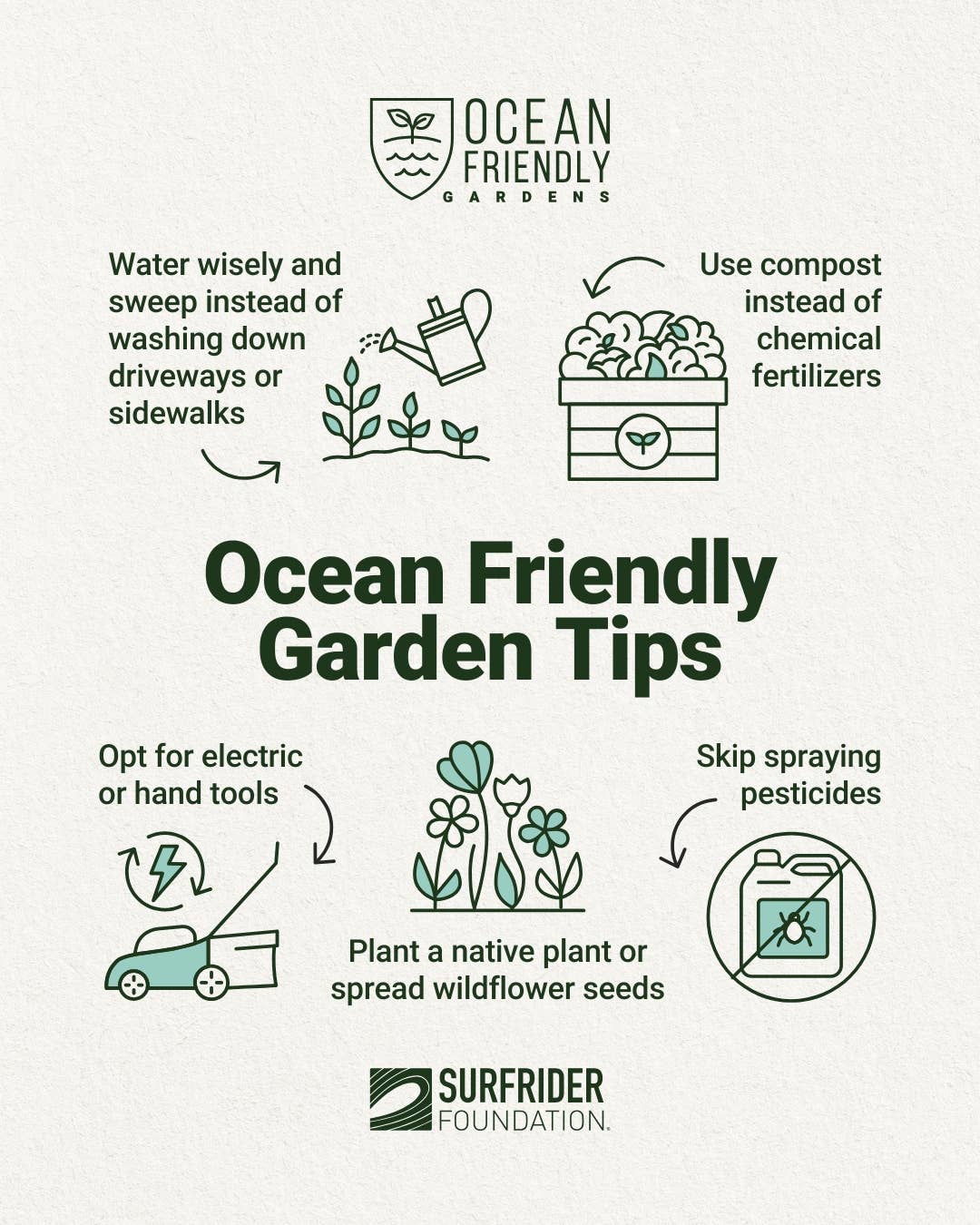
Surfrider has been hard on the case since 2013 with its Ocean Friendly Gardens (OFG), a nationwide initiative to ”restore the natural functions of healthy watersheds by contouring landscapes for rainwater retention, directing water back into the ground instead of storm drains.”
Courtesy Surfrider Foundation
You might see rain gardens around your city or town, and it’s a wonderful thing that our public coffers are managing to dole out even that much for environmental restoration and flood mitigation, but there are complexities and nuances to building successful rain gardens that, in many cases, don’t get considered by these larger-scale public efforts. Namely, as Surfrider points out: “The extensive root systems of native plants help naturally filter pollutants and sponge up extra water while restoring biodiversity to our urban landscapes.”
“We have 33 Ocean Friendly Gardens registered to the map nationwide, a mix of chapter-led projects, homes, and ambassador gardens,” says Kathryn Dressendofer, Surfrider Foundation’s Ocean Friendly Gardens Program Coordinator based in Southern California. The “rain gardens” vary widely in size, some as small as a rain garden you might find on a New York City sidewalk (Surfrider is, by the way, installing rain gardens there, too), while others span more than an acre.
Depending on local municipalities, installation can prove difficult. In New York City, for example, the Department of Environmental Protection (DEP) reserves exclusive authorization. “I often see them with absolutely no plants in them, and I wish I could be involved with the native plant selection and organizing better maintenance,” says Surfrider NYC’s Climate Action Program Lead, Adriana Jovanovic. “But I’m not sure how much investment the DEP has in the existing rain gardens. Some look decent; Others, not so much. Hopefully the sad ones still absorb and retain water, despite lacking the roots to really do this well.”
It’s been a slow, trying start across the board, but if any nonprofit organization has the perseverance, it’s Surfrider. A decade and change in, its OFG program is making strides and continuing to dedicate time, money, and volunteer hours to helping stave off the results of untreated runoff by slowing down the flow into already over-pressured storm drains altogether while also replenishing groundwater supplies.
“One of the challenges of scaling up the OFG program nationwide is just the awareness of how our actions upstream can impact water quality at the coast. We generally have a very disconnected understanding of our water systems, and have treated rainwater and runoff as a problem that needs to be plumbed away from us as fast as possible. Realizing that we can use that same water to grow plants that cool and shade our communities, support biodiversity, while also alleviating pollution problems downstream makes sense to a lot of people who care about these issues. A big part of the solution is starting these conversations in our communities and with municipalities, advocating for thinking outside of the box and working with nature instead of against it.”
Visit Surfrider’s Ocean Friendly Gardens homepage to learn more, learn about OFG criteria, and find out how you (and/or your community) can get involved. For more information or questions, contact Kathryn Dressendorfer, Southern California Ocean Friendly Gardens Coordinator at kdressendorfer@surfrider.org.