



Does anybody recall the roughly 3.6 million pounds of high-level radioactive waste that is looming between California Interstate 5 and the Pacific Ocean to the east and west, respectively, and Trestles Wetland Natural Preserve to the north and San Onofre State Park to the south? As it so happens, new shit has come to light. Apparently, the canisters that have contained all that delectable poison are not only short-term storage solutions, but they also appear to be compromised, according to 2019 images obtained from Southern California Edison (SCE) by local community advocacy organization San Clemente Green (SCG) during a Community Engagement Panel.
Considering this choicest of seaside locales (here’s a map) and surf meccas, one might mistake the subject in question for an errant can of Budweiser gone a-skunk in the sun that nobody can be bothered to claim, address, or—a novel idea—perhaps even safely deposit in an appropriate receptacle, if not right this instant then maybe ahead of the Los Angeles Summer Games in 2028?
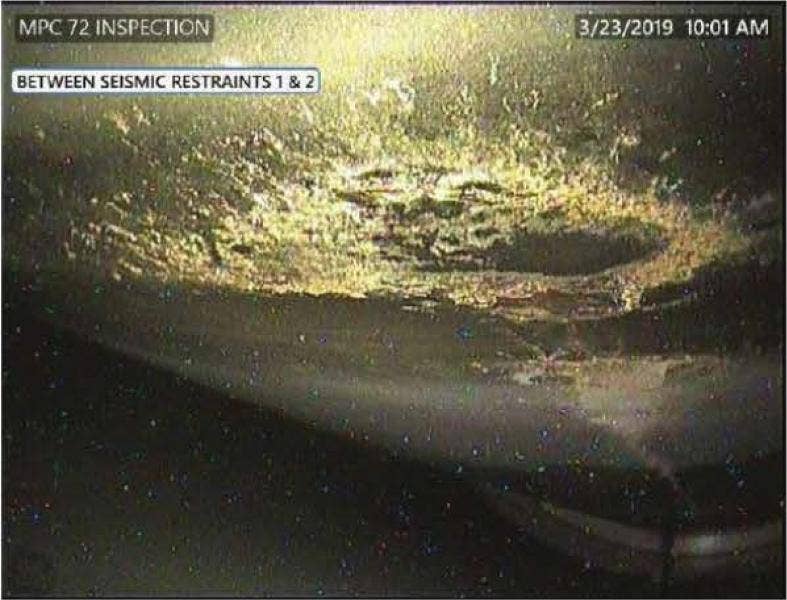
Courtesy San Clemente Green
Come July of that not-so-far-off year, the AI robots reckon upwards of a few thousand humans will descend upon these hallowed surfing grounds to watch the sport make its olympic debut stateside, with many millions more watching from home, when the proximity of all that hazardous material will be made known one way or another. It will also make for some not-so-nice public relations for this nation whose reputation is not currying much abroad at this moment in time as it stands. Spectatorship aside, a more important statistic is that, according to California State Parks, San Onofre alone sees roughly 2.5 million visitors annually—and most of those visitors are our very own country folk.
Much as we’ve tried to make sense of this cornucopia of toxicity being dedicated some of the U.S. of A.’s—and the globe’s—finest real estate, we are as stymied as the various lawyers, public interest groups, and other concerned parties at our side who are far wiser and more attuned to the ins and outs of this impending crisis. Make no mistake, this is an 1,800-ton snake in the grass.
But while it is not the soylent green sludge we are all envisioning, and natural disasters like earthquakes and tsunamis don’t pose any likely threats as Scripps and Surfrider previously told SURFER, we’re far from out of the weeds. The 73 spent fuel canisters were recently moved from cooling tanks to dry-cask storage, where they’ll have to chill until about 2030, or a decade all said and done.
Should that time come, where will the waste go for “permanent” storage? A recent US Supreme Court ruling cleared the way for more temporary nuclear waste storage in both Texas and New Mexico, but permanent solutions remain at large, SCG founder and president Gary Headrick told SURFER of the ruling, adding: “It may have taken us one step closer to Consolidated Interim Storage, but it is one of many difficult steps to come.”
Can the damaged canister(s) withstand another five years? With SCE only disclosing so much as a handful of grainy photos of the canister in question wedged between “seismic restraints”—at least there are seismic restraints?—how is the public to know the dilemma we and all the unwitting critters at its mercy face?
SCE, which is reportedly “rewarded for overseeing this stranded nuclear waste to the tune of two million dollars a day,” according to SCG, on behalf of the Department of Energy until that administration takes over liability—when or whether that will happen, as the materials first have to be suitable for transportation is anyone’s guess. “Conclusions” regarding the concern of the damaged temporary storage canisters are limited to a lone bullet point, but read as follows: “Scratches are still bright and shiny, no evidence of corrosion or chloride-induced stress corrosion cracking precursor activity.”
The main problem with the temporary containers is twofold: 1) They have to last long enough until the waste has cooled down, and 2) If the canisters are not repackaged for transportation and subsequent relocation, they’ll be stranded in place—perhaps forever.
Visit San Clemente Green’s website to stay informed and get involved, and for a comprehensive state of the San Onofre Nuclear Generating Station, watch non-profit Ecological Options Network’s (free) film San Onofre Syndrome.